Pathology|
Powdery mildew in grapevines: conditions, spore counts and spray timing
Powdery mildew doesn't need rain to infect. How it starts, when bunches are most at risk, and what spore counts add to spray timing.

BioScout
6 Min Read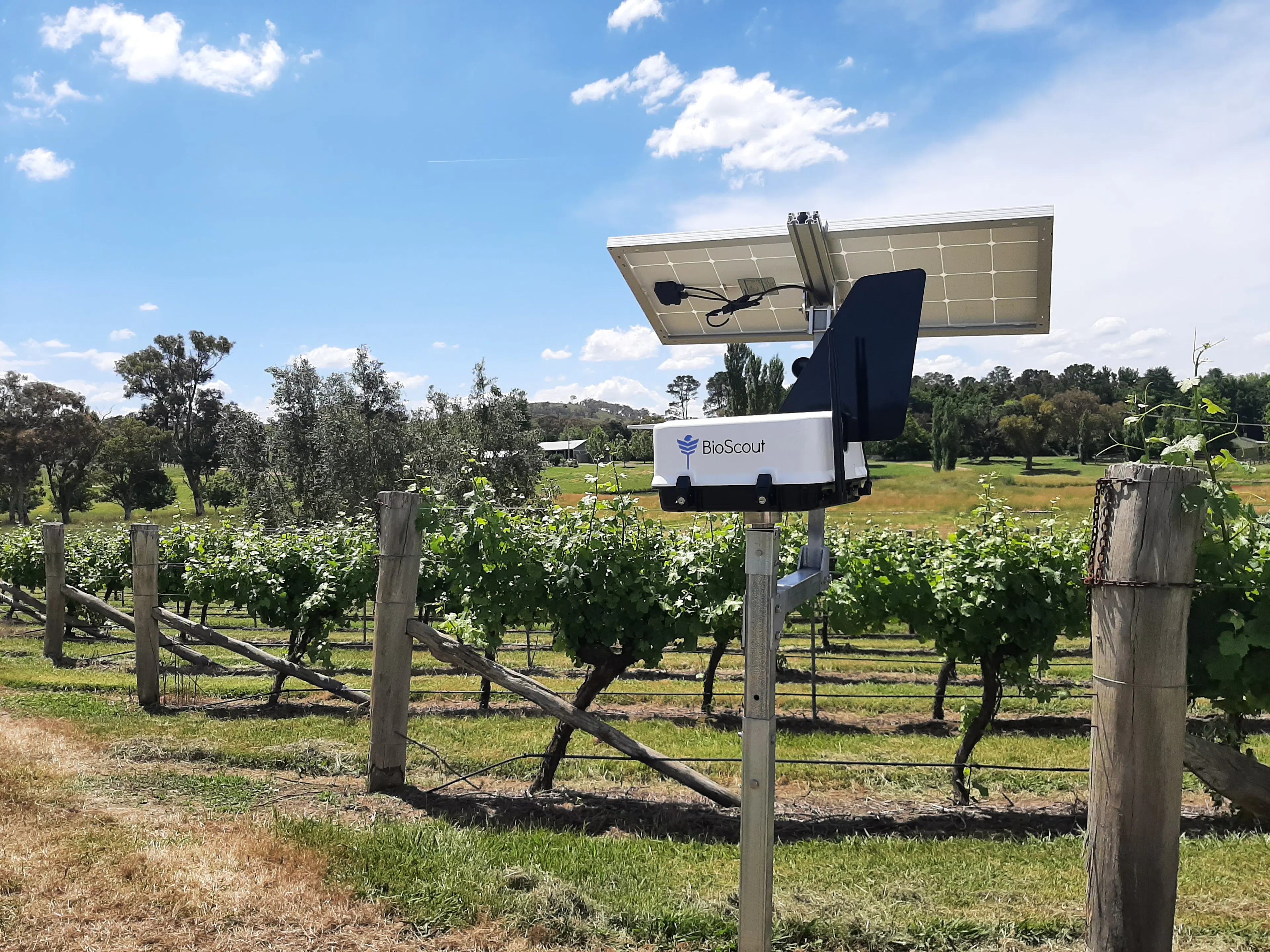
SporeScout unit in a vineyard
Once established, powdery mildew does not need rain to infect. Unlike downy mildew, its spores germinate on a dry leaf, so a warm, dry, overcast week can drive more infection than a wet one. That makes rain-based rules less useful for powdery mildew, and it makes knowing whether spores are in the air more useful. This guide covers how the disease starts and spreads, when bunches are most at risk, and what spore counts add to spray timing.
Where it starts
The fungus, Erysiphe necator, survives winter in two ways.
The first is in infected buds. Buds infected the previous spring burst as stunted, distorted flag shoots covered in white growth, usually only a small share of shoots, depending on the variety, and more after a bad season. They are easiest to find three to six weeks after budburst.
The second is as chasmothecia, tiny black fruiting bodies that form on heavily infected leaves and bunches from mid-summer and overwinter on bark and mummified bunches. In spring, at least 2.5 mm of rain or irrigation at more than 10°C releases their ascospores. Australian work has found 5,000 to 20,000 chasmothecia per kilogram of bark at budburst on Chardonnay, against 100 to 2,000 on Sultana, so variety and last season's disease both shape this season's starting point.
How it spreads
Once the first infections are established, they produce conidia, the powdery white spores that give the disease its name. Conidia spread on air currents and germinate without free water, at relative humidity above about 40%. Conditions that suit them:
- temperatures of 20 to 30°C (growth slows on exposed leaves above 35°C)
- cloudy weather and low to moderate light
- shaded, dense canopies, sheltered sites and blocks with a history of the disease
At 23 to 30°C, a new generation of spores can be produced in about five days. AWRI notes that around 40 days after budburst, spore numbers can rise sharply if early control has been poor. Each generation multiplies the next, which is why early-season control decides how hard the rest of the season will be.
When bunches are most at risk
The critical period for bunches runs from just before flowering to fruit set. In unsprayed South Australian trials, bunch infection climbed quickly around flowering. AWRI's guidance is that berries resist new infection three to five weeks after flowering, but berry stems and bunch stalks stay susceptible for longer.
The damage shows at the winery. AWRI notes that 3 to 5% disease can lead wineries to reject fruit, and Australian research found changes in Chardonnay juice and wine at just 1 to 5% of bunches affected, including oily mouthfeel and earthy, cooked-tomato aromas. Infected berries can also split and let in bunch rot. Severe outbreaks reduce vine vigour for several seasons.
Prevention first
Fungicides work best as protectants, applied before infection. Some products can knock back early colonies, but none repairs damaged fruit, so timing and coverage are everything. Australian guidance:
- Start early. On blocks with a history of mildew, start protection at 5 to 10 cm of shoot growth.
- Keep intervals tight. Seven to 10 days under high pressure, shorter during rapid growth around flowering. Intervals that are too long, and programs that start too late, are the most common causes of poor control.
- Cover the bunches. Sulphur is a cheap contact protectant and works best in the early sprays, when coverage is easiest. Around flowering, systemic and translaminar products such as Group 3 (DMI) and Group 11 (QoI) are commonly used.
- Rotate. Australian monitoring has found reduced sensitivity, and in more recent samples, resistance, to Groups 3, 11 and 13. Programs using three chemistries controlled bunch mildew better than those using one or two. Check current registrations and resistance advice before each season.
What spore counts add
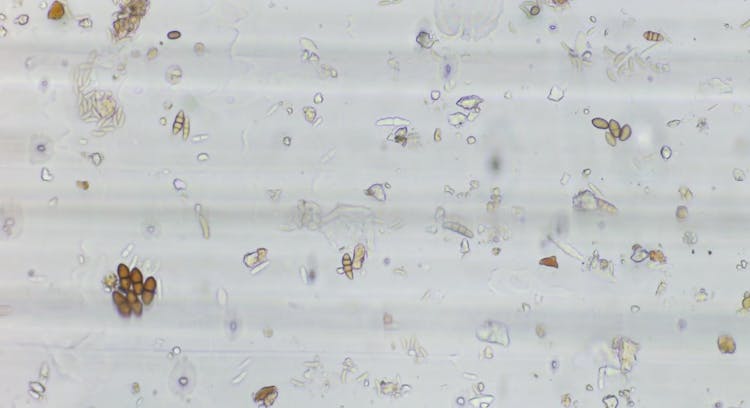
Because powdery mildew does not need rain, the question that matters most is whether spores are in the air. A SporeScout samples the vineyard air every day, takes 220 microscope images at 400x magnification and counts Erysiphe conidia, so you can see the first conidia of the season and watch them build.
The strongest evidence for using spore counts comes from Oregon's Willamette Valley, where researchers trapped airborne powdery mildew spores in commercial vineyards:
- Starting the spray program at the first spore detection, instead of at a fixed shoot length, saved an average of 3.25 sprays per season, with no significant difference in leaf or berry disease (Thiessen and colleagues, 2016).
- Adjusting spray intervals to airborne spore levels saved 2.3 sprays in one season and 1.6 in the next, again with no significant difference in disease (Thiessen and colleagues, 2017).
In Australia, spore traps run by SARDI and AWRI have detected the pathogen before symptoms appeared, but that work has focused on tracking fungicide resistance rather than spray timing. We are not aware of any Australian trial that has yet linked spore counts to the timing of the first spray, so treat the Oregon results as a strong lead rather than a local rule.
In practice:
- Before the first spray: watch for the first conidia of the season, especially on blocks with flag shoots or a history of disease.
- From pre-flowering to fruit set: if counts are rising, keep intervals at the short end and make sure bunches are covered.
- After fruit set, with low counts: consider whether intervals can stretch, alongside scouting and your agronomist's advice.
Keep walking the rows. Flag shoots and early leaf colonies are the signs to act on, and logging what you find alongside the spore data builds a picture of each block over the season.