Pathology|3 Nov 2026
Downy mildew in Australian vineyards: what sporangia counts tell you before oil spots appear

BioScout
5 Min Read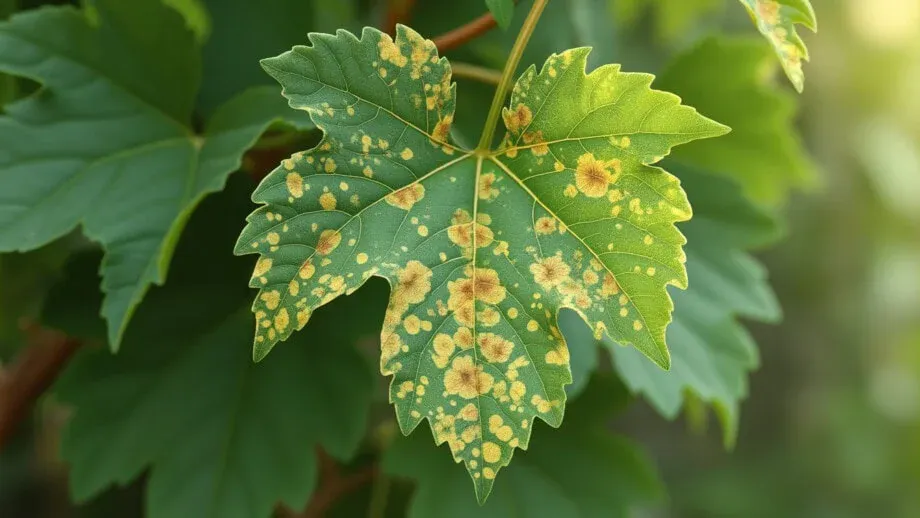
Downy mildew needs three things to infect a vine: the pathogen, Plasmopara viticola, the susceptible host, and the right weather. Most spray decisions are made on the weather and susceptible crop stage alone.
Daily counts of downy mildew sporangia in the air help you understand the situation better. This information is provided before you see oil spots on the leaves.
This guide explains how the infection cycle works. It also tells you when Australian vineyards are most at risk. Finally, it shows how to use spore counts with the rules you already know.
Where the season starts: oospores and the 10:10:24 rule
Downy mildew survives winter as oospores, thick-walled resting spores in leaf litter and soil. The Australian Wine Research Institute (AWRI) estimates they stay viable in vineyard soil for three to five years.
In spring, oospores in wet soil germinate and form sporangia, which release swimming zoospores. Rain splash carries them up onto the canopy. They swim in the film of water on the vine and infect through stomata, mostly on leaf undersides but also on shoots, flower clusters and young bunches.
This is primary infection, and Australian growers know its trigger as the 10:10:24 rule: at least 10 mm of rain (or overhead irrigation) within 24 hours, with temperatures staying at or above 10°C.
The rule is a guide, not a guarantee. If 10:10:24 has not happened, primary infection is unlikely. If it has, infection is possible but may still not occur. Primary infection is also sparse: AWRI puts it at around one to three oil spots per 50 metres of row.
The secondary cycle: where the damage comes from
The real threat is what those first few oil spots do next. On a warm, humid night, each oil spot produces sporangia, on branched structures called sporangiophores, which form the white down on the underside of the leaf. AWRI lists the conditions:
● relative humidity of 98% or more
● temperature of 13°C or more (the optimum is 20 to 25°C)
● at least four hours of darkness
● leaves wet for two to three hours before dawn
Wind and rain carry the sporangia through the vineyard. Where one lands on a wet leaf, it releases zoospores and starts a new infection. AWRI estimates that one warm, humid night of sporulation from as few as 20 to 50 oil spots can lead to around 100,000 secondary oil spots within a 50 metre radius, once the incubation period has passed.
The invisible window
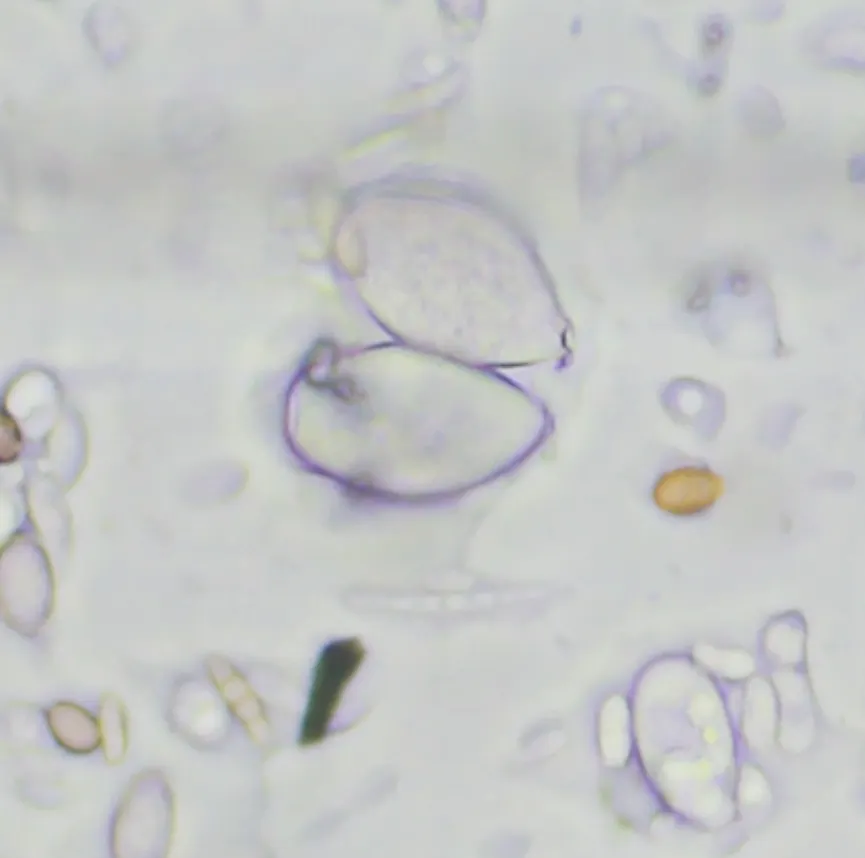
Downy Mildew Sporangia microscopy
Between infection and the first oil spot there is a delay of 4 to 21 days, depending on temperature and susceptibility of the host. For that whole period the infection is in the leaf and nothing shows. By the time you see oil spots, the next generation of sporangia may already be in the air.
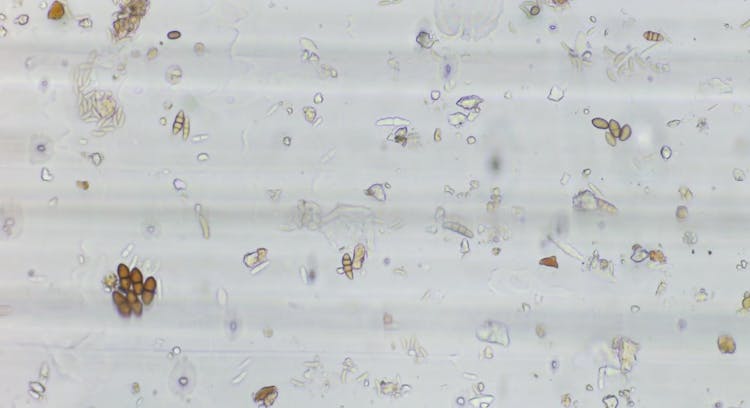
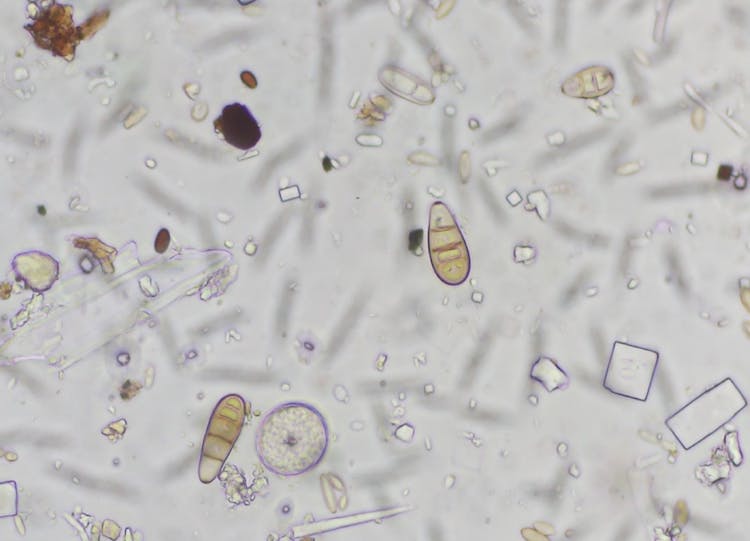
This is where sporangia counts help. A SporeScout unit samples the air in the vineyard every day, takes microscope images of what it catches at a 400X magnification, and our automated AI algorithm counts the downy mildew sporangia. A rising count tells you secondary spread is under way before you would normally find the symptoms.
When the risk is highest
AWRI says the highest risk is from three to six weeks after budburst until the berries are the size of peas. This is especially true when late spring and early summer are warm and wet.
Vines are most susceptible from when shoots reach about 10 cm until berries are pea-sized, so it is recommended to take particular care through flowering. Severe infection around flowering can cause total crop loss on affected bunches. Berries become resistant to infection 2 to 3 weeks after flowering, but the bunch stem (rachis) can stay susceptible for up to two months after flowering.
For many southern Australian regions, that window runs through November.
What sporangia counts add, and what they don't
Weather rules tell you when conditions suit infection. A sporangia count tells you whether the pathogen is in the air to take advantage of them. The two together are more useful than either alone.
Published research supports this. A 2020 study in Italian vineyards (Brischetto and colleagues, Frontiers in Plant Science) Researchers collected air samples daily for three seasons. Counts in the days before leaf sampling were related to the number of lesions that followed.
The counts were most useful in determining if there was no infection. When the number of healthy sporangia was below a low limit, saying "no infection" was correct 87% of the time. Without the counts, it was only correct 57% of the time.
There is one important limit. The season's primary infection comes from oospores in the soil, splashed up by rain, not from sporangia in the air. A low count early in spring does not rule out primary infection after a 10:10:24 event. Sporangia counts earn their keep in the secondary cycle, which is where most of the damage, and most of the spray decisions, sit.
Timing the first spray
Most downy mildew products registered in Australia are protectants, such as copper (Group M1) and mancozeb (Group M3). They have to be on the leaf before infection, as close to the event as practical, with good coverage of the leaf undersides.
Post-infection sprays need to go on as soon as possible after the infection event and before oil spots appear. It is recommended to check the label for each product's post-infection window.
AWRI recommends using Group 4 products only curatively: as soon as possible after an infection event and before oil spots appear, always mixed with another product such as copper, and followed by a second Group 4 spray 7 to 10 days later. Follow the CropLife resistance management strategy and the product label, and rotate chemical groups through the season.
In practice, sporangia counts help in three ways:
1. Rising sporangia and a warm, humid forecast: get protection on before the next likely infection night.
2. Low sporangia through a wet spell: after the first protective spray, weigh whether the next scheduled spray is needed, alongside scouting and your agronomist's advice (Remember that heavy rain can still trigger primary infection from oospores, whatever the count).
3. After an infection event: the count, the weather record and the 4 to 21 day incubation period together tell you when to look for oil spots.
In 2024-25, a grower in New Zealand did exactly this. After the usual early-season mancozeb spray, downy mildew counts on the dashboard stayed lower than the season before, so the grower held further downy mildew sprays alongside scouting and weather. Counts stayed low through to harvest. Compared with 2023–24, the vineyard avoided four copper applications and saved $258 per hectare in direct
spray costs. [Read the case study]
Keep scouting
Sporangia counts do not replace walking the rows. Check leaf undersides after warm, humid nights, record what you find, and treat the counts as one more piece of evidence, delivered every morning.
Over the coming weeks we will publish guides to powdery mildew and botrytis, the other two diseases on most vineyard dashboards this season.